
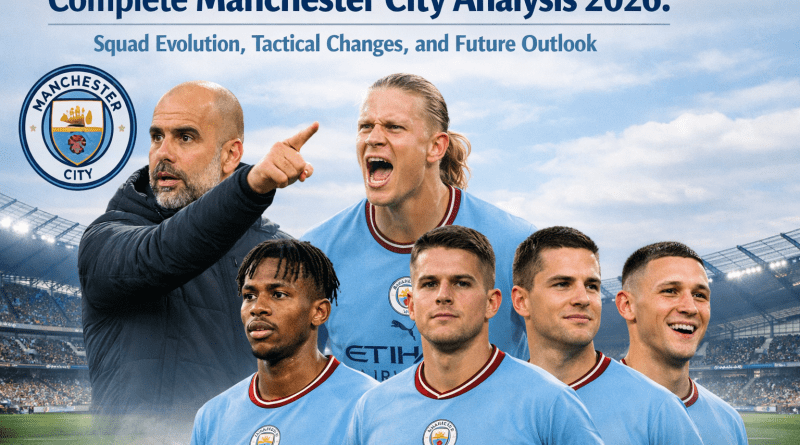
Complete Manchester City Analysis 2026: Squad Evolution, Tactical Changes, and Future Outlook
Manchester City in 2026: A Team in Transition Rather Than Dominance
For nearly a decade, Manchester City set the standard for modern football. However, the 2025/26 season has marked a significant transition period for the club. While City remained competitive across all competitions and finished second in the Premier League, this campaign revealed a side adapting to a new reality rather than simply overpowering opponents.
The departures of key figures such as Kevin De Bruyne, Kyle Walker, and Ederson forced Pep Guardiola to rethink several aspects of his system. Bernardo Silva inherited the captaincy, while a new generation of players was tasked with carrying the club forward.
The End of an Era: Life After Kevin De Bruyne
Perhaps the biggest story surrounding Manchester City has been the absence of Kevin De Bruyne. For years, the Belgian midfielder was the creative engine behind City’s attacking dominance. His departure left a tactical and emotional void that could not be replaced by a single player.
Instead, Guardiola has distributed creative responsibilities across multiple players. Phil Foden, Bernardo Silva, Jérémy Doku and Omar Marmoush have all been given greater freedom to create chances and attack spaces between defensive lines.
The result is a less predictable but also less controlled attacking structure compared to previous City teams.
Tactical Evolution Under Guardiola
One of the most interesting developments this season has been Guardiola’s tactical adaptation. Rather than relying exclusively on the classic possession-heavy 4-3-3, Manchester City has frequently used a 4-1-4-1 system, which has become the team’s primary structure. This setup provides more balance between possession control and defensive stability.
Several tactical trends have emerged:
More Direct Attacking Football
City’s football in 2026 is noticeably more vertical. Guardiola has introduced greater emphasis on transitions and direct attacking sequences, moving away from the slower positional attacks that defined his peak years.
Improved High Pressing
The arrival of assistant coach Pepijn Lijnders has influenced City’s pressing structure. The team now applies pressure more aggressively and seeks to win possession closer to the opponent’s goal. Analysts have highlighted this as one of the most significant improvements compared to the previous campaign.
Greater Tactical Flexibility
City has alternated between multiple formations during the season, including:
- 4-1-4-1
- 4-3-3
- 4-3-2-1
- Hybrid systems with inverted full-backs
This flexibility has allowed Guardiola to adapt to injuries and different opponents more effectively.
Key Players Driving Manchester City Forward
Erling Haaland
Despite tactical changes around him, Erling Haaland remains the focal point of City’s attack. He finished the season as the club’s leading scorer with 37 goals across all competitions and 26 in the Premier League.
His partnership with the creative players behind him continues to be City’s most dangerous weapon.
Jérémy Doku
Doku has arguably become one of the biggest winners of City’s tactical evolution. Guardiola has used him in more central positions rather than keeping him isolated on the wing, allowing him to exploit spaces between midfield and defense. This adjustment significantly increased his influence in the final third.
Bernardo Silva
As captain, Bernardo Silva has taken on greater leadership responsibilities while remaining one of City’s most technically gifted players. However, speculation regarding his long-term future continues to surround the club.
Omar Marmoush
Following his return from international duty, Marmoush became an important contributor during the second half of the season. His movement, pace, and ability to attack space added a different dimension to City’s frontline.
Defensive Concerns Remain
While City’s attack remains among the strongest in England, defensive consistency has occasionally been an issue.
Analysts have pointed to build-up problems against aggressive pressing teams and difficulties defending fast transitions. These weaknesses became particularly visible in high-profile matches against elite opposition.
The injury suffered by Joško Gvardiol during the season also reduced defensive stability for several months.
Transfer Activity and Squad Development
Manchester City’s recruitment strategy has shifted toward adding athleticism and transitional threat.
The arrivals of players such as Antoine Semenyo and Marc Guéhi were designed to inject greater physicality, speed, and defensive reliability into the squad. Both signings have influenced Guardiola’s tactical adjustments during the second half of the campaign.
Meanwhile, reports suggest City remains active in the transfer market, with midfield reinforcements expected as the club prepares for another squad rebuild.
Guardiola’s Departure Changes Everything
The biggest development surrounding Manchester City is undoubtedly Pep Guardiola’s decision to step down after the 2025/26 season, ending a remarkable decade at the club. During his tenure, City won multiple Premier League titles, domestic cups, and the Champions League while revolutionizing English football tactically.
His departure raises several questions:
- Can City maintain the same football identity?
- Will the next manager continue Guardiola’s philosophy?
- How many senior players will leave alongside the coach?
The answers to these questions will define Manchester City’s next era.
Conclusion
Manchester City remains one of the strongest teams in world football, but the club is clearly entering a new phase. The 2025/26 season showcased a side evolving beyond its traditional Guardiola blueprint, embracing greater tactical flexibility, more direct attacking football, and a younger core of players.
With Erling Haaland leading the attack, emerging talents taking on bigger roles, and significant changes expected in the managerial position, Manchester City stands at a fascinating crossroads. The club’s challenge is no longer reaching the top—it is staying there after the departure of the coach who built one of football’s greatest dynasties.