
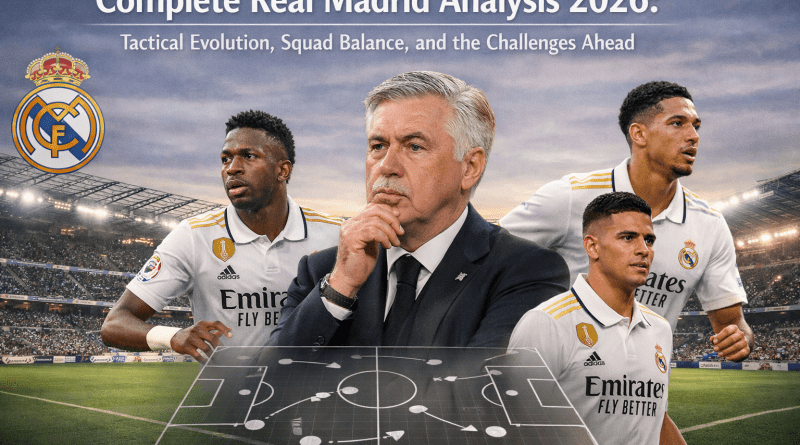
Complete Real Madrid Analysis 2026: Tactical Evolution, Squad Balance, and the Challenges Ahead
Real Madrid in 2026: Star Power Without Complete Stability
Real Madrid remains the biggest football club in the world, but the 2025/26 season highlighted a reality that many supporters were reluctant to acknowledge: individual brilliance alone is no longer enough to dominate modern football.
Despite boasting a squad featuring Kylian Mbappé, Vinícius Júnior, Jude Bellingham, Federico Valverde, Aurélien Tchouaméni, and Thibaut Courtois, Los Blancos finished the season without a major trophy. The club ended second in La Liga, exited the UEFA Champions League in the quarter-finals, and failed to win either the Copa del Rey or the Spanish Super Cup.
The result was one of the most disappointing campaigns in recent Real Madrid history, raising serious questions about tactical identity, squad balance, and long-term planning.
The Mbappé Era Has Officially Begun
If there is one positive takeaway from the season, it is the extraordinary form of Kylian Mbappé.
The French superstar established himself as Real Madrid’s primary attacking force, finishing the season with 42 goals across all competitions and winning the Pichichi Trophy as La Liga’s top scorer. He was also voted Real Madrid Player of the Season thanks to his consistent goal production and attacking output.
However, Mbappé’s success also exposed one of Madrid’s biggest structural problems.
Both Mbappé and Vinícius Júnior prefer operating from the left side and attacking similar spaces. While each player is world-class individually, finding the perfect tactical balance between them remains one of the club’s biggest challenges. Several analysts and supporters have questioned whether the partnership truly maximizes the strengths of both players.
Jude Bellingham: The Midfield Leader
Since arriving in Madrid, Jude Bellingham has become far more than a traditional midfielder.
His ability to contribute defensively, progress the ball, create chances, and score goals makes him arguably the most complete player in the squad. Even after dealing with injury concerns during the season, he remained one of the team’s most influential performers.
At only 22 years old, Bellingham is widely viewed as one of the future leaders of both Real Madrid and England.
Vinícius Júnior Remains Essential
Despite criticism during parts of the season, Vinícius continues to be one of the most dangerous wingers in world football.
The Brazilian recently stated that he feels at the best physical and technical level of his career. When operating in space, few defenders can cope with his acceleration, dribbling ability, and directness.
The challenge for Madrid is not whether Vinícius is good enough—it is how to integrate him effectively alongside Mbappé without sacrificing overall team balance.
Tactical Revolution Under Xabi Alonso
The most significant change of the season was the appointment of Xabi Alonso.
After years of relying heavily on individual quality under Carlo Ancelotti, Real Madrid attempted to implement a more structured tactical model. Alonso sought to introduce higher pressing, better positional organization, and greater control without possession.
Several tactical trends became evident:
Higher Defensive Pressure
Madrid pressed more aggressively than in previous seasons.
The objective was to recover possession closer to the opponent’s goal and reduce vulnerability during defensive transitions. Statistical analysis showed a noticeable increase in high turnovers leading directly to attacking opportunities.
More Structured Possession
Unlike previous seasons, where attacking sequences often depended on moments of individual brilliance, Alonso attempted to create clearer positional patterns during build-up phases.
Greater Defensive Organization
One of the coach’s priorities was improving Madrid’s defensive structure after several seasons of instability against elite opponents. The team became more compact and better prepared to counter opposition transitions.
Why Real Madrid Still Struggled
Although Alonso introduced several positive tactical concepts, the transition was far from smooth.
Reports throughout the season suggested that parts of the squad struggled to adapt to the increased tactical demands. Some observers argued that Real Madrid lacked a clear identity during crucial moments of the campaign, while others pointed to squad imbalance and injuries as major obstacles.
The midfield also lacked a true deep-lying playmaker capable of controlling matches consistently after the departures of club legends who had defined the previous era.
Defensive Strengths and Weaknesses
Real Madrid still possesses elite defensive talent.
Thibaut Courtois remains one of the world’s best goalkeepers, while Éder Militão, Antonio Rüdiger, and emerging young defenders provide strong individual quality.
However, defensive injuries and inconsistent collective organization occasionally exposed weaknesses against high-level opposition. These issues became particularly noticeable in matches against Barcelona and other elite European clubs.
The Future Core of Real Madrid
Looking ahead, Real Madrid’s foundation remains incredibly strong.
Key players expected to define the next era include:
- Kylian Mbappé
- Jude Bellingham
- Vinícius Júnior
- Federico Valverde
- Aurélien Tchouaméni
- Eduardo Camavinga
- Arda Güler
- Endrick
This combination of elite stars and emerging talent gives the club one of the most valuable squads in world football.
Can Real Madrid Return to the Top?
The answer is almost certainly yes.
Unlike many clubs facing rebuilding phases, Real Madrid does not lack talent. The real challenge is creating tactical cohesion around some of the world’s biggest stars.
If the club successfully balances the attacking partnership of Mbappé and Vinícius, strengthens midfield control, and develops a clearer collective identity, it possesses all the ingredients required to dominate both La Liga and the Champions League once again.
The 2025/26 season may ultimately be remembered not as a failure, but as the painful transition period that shaped Real Madrid’s next great generation.
Conclusion
Real Madrid enters 2026 with enormous potential but significant questions to answer. The squad remains packed with world-class talent, led by Kylian Mbappé, Jude Bellingham, and Vinícius Júnior, yet the club is still searching for the tactical balance that can transform individual excellence into sustained dominance.
The coming seasons will determine whether Los Blancos can build a new dynasty or continue relying on moments of brilliance from some of football’s biggest stars. One thing remains certain: whenever Real Madrid faces adversity, history suggests they rarely stay down for long.