
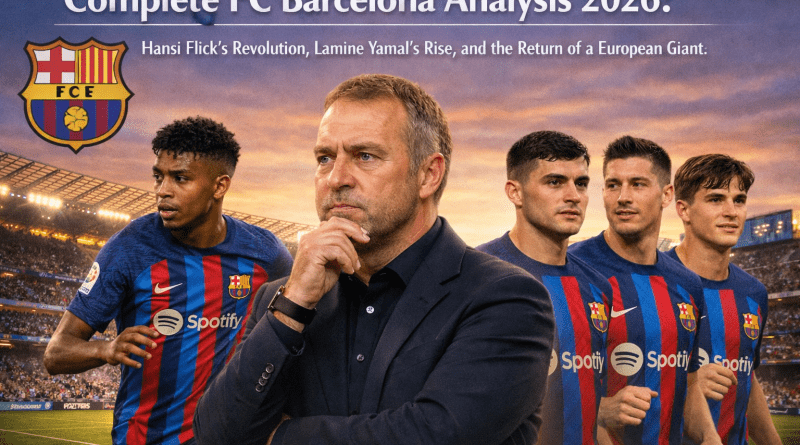
Complete FC Barcelona Analysis 2026: Hansi Flick’s Revolution, Lamine Yamal’s Rise, and the Return of a European Giant
Barcelona in 2026: The Beginning of a New Golden Era
After years of financial instability, squad rebuilding, and inconsistency, FC Barcelona has finally re-established itself among Europe’s elite. The 2025/26 season confirmed that the club is no longer simply rebuilding—it is competing for major trophies again.
Under Hansi Flick, Barcelona secured a second consecutive La Liga title, finishing the campaign with 94 points and ending Real Madrid’s challenge with a decisive El Clásico victory. The team also retained the Spanish Super Cup, making it another successful season for the Catalan giants.
More importantly, Barcelona now possesses something it lacked for several years: a clear football identity.
Hansi Flick Has Transformed Barcelona
When Flick arrived in 2024, many expected him to bring intensity and discipline. Few expected the speed at which he would rebuild the team’s mentality.
The German coach recently extended his contract until 2028 after leading Barcelona to back-to-back league titles. His influence goes far beyond tactics. Players, staff, and club officials frequently describe the dressing room atmosphere as one of the biggest reasons behind the club’s resurgence.
Unlike previous Barcelona projects that relied heavily on possession for its own sake, Flick’s version combines traditional Barça principles with modern vertical football.
The result is a team capable of dominating possession while remaining aggressive and direct.
Lamine Yamal Has Become Barcelona’s New Superstar
Every great Barcelona era has had a defining figure.
For Guardiola’s generation it was Lionel Messi.
For the current project, it is increasingly becoming Lamine Yamal.
At just 18 years old, Yamal was named La Liga Player of the Season after recording 16 goals and 12 assists while playing a decisive role in Barcelona’s title-winning campaign.
What makes Yamal special is not only his technical ability.
He already dictates matches.
Barcelona increasingly attacks through his side, trusting him to create chances, break defensive structures, and provide moments of brilliance in crucial matches. His performances in El Clásico and Champions League fixtures have established him as one of the most valuable young players in world football.
The Importance of Pedri
While Yamal receives much of the attention, Pedri remains the player who controls Barcelona’s rhythm.
The Spanish midfielder has evolved into the team’s primary organizer, dictating tempo, progressing possession, and connecting every phase of play.
Analysts repeatedly highlighted his influence throughout the season, particularly in matches where Barcelona dominated possession and controlled territory. His partnership with Marc Bernal, Frenkie de Jong, and Dani Olmo has provided balance between creativity and control.
When Pedri performs at his highest level, Barcelona often looks impossible to press.
Raphinha’s Reinvention
One of the most remarkable stories of the Flick era has been Raphinha’s transformation.
Instead of remaining a traditional winger, the Brazilian has been given freedom to move centrally and attack spaces around the striker.
This tactical adjustment dramatically increased his effectiveness.
Even after missing part of the season through injury, Raphinha returned to become one of Barcelona’s most productive attacking players, contributing goals, assists, and leadership. His movement between the lines has become a crucial element of Flick’s attacking system.
Tactical Analysis: Why Barcelona Is So Difficult to Stop
High Pressing and Aggressive Defending
The foundation of Flick’s system remains intense pressing.
Barcelona applies pressure immediately after losing possession, attempting to recover the ball as close to the opponent’s goal as possible.
This aggressive approach forces mistakes and allows the team to sustain attacks for long periods. However, it also requires exceptional physical conditioning and concentration.
Vertical Attacking Football
Unlike the slower possession football often associated with Barcelona, Flick encourages quicker progression through midfield.
The objective is not merely to keep possession but to create scoring opportunities as rapidly as possible.
This combination of possession and verticality has made Barcelona one of the most entertaining teams in Europe.
Possession Still Matters
Despite the tactical evolution, Barcelona remains faithful to its DNA.
The club finished the league season with nearly 69% average possession, the highest figure in La Liga. The team also scored 95 league goals and produced more shots than any other Spanish side.
The difference is that possession is now used more aggressively and with greater purpose.
The Defensive Foundation
Young defenders such as Pau Cubarsí have become key components of Barcelona’s future.
Alongside Jules Koundé, Alejandro Balde, Ronald Araújo, and emerging academy products, the club possesses one of the youngest defensive units among Europe’s elite teams.
The high defensive line remains one of Flick’s defining tactical features.
While this approach occasionally leaves space behind the defense, it allows Barcelona to compress the field and dominate territorial battles.
Areas That Still Need Improvement
Despite winning La Liga, Barcelona is not yet a perfect team.
Several issues remain:
- Dependence on Lamine Yamal during difficult matches.
- Vulnerability against elite counterattacking sides.
- Need for additional squad depth in defense.
- Long-term planning for Robert Lewandowski’s eventual replacement.
Club officials have already hinted that further signings are expected during the summer transfer window.
The Future Looks Extremely Bright
Perhaps the most exciting aspect of Barcelona’s project is the age profile of the squad.
The club’s core includes:
- Lamine Yamal
- Pedri
- Pau Cubarsí
- Alejandro Balde
- Marc Bernal
- Fermín López
- Gavi
Combined with experienced leaders and strategic additions, Barcelona possesses one of the strongest foundations in European football. The continued success of La Masia remains central to the club’s long-term vision.
Conclusion
Barcelona enters the 2026/27 season as the dominant force in Spanish football. Hansi Flick has successfully blended the club’s traditional possession-based philosophy with modern pressing, vertical attacks, and tactical intensity.
With Lamine Yamal emerging as a global superstar, Pedri controlling matches from midfield, and a talented young core developing rapidly, Barcelona appears better positioned than at any point since the peak Messi era.
For the first time in years, Barcelona is not only winning trophies—it is building a project capable of dominating European football for the next decade.