
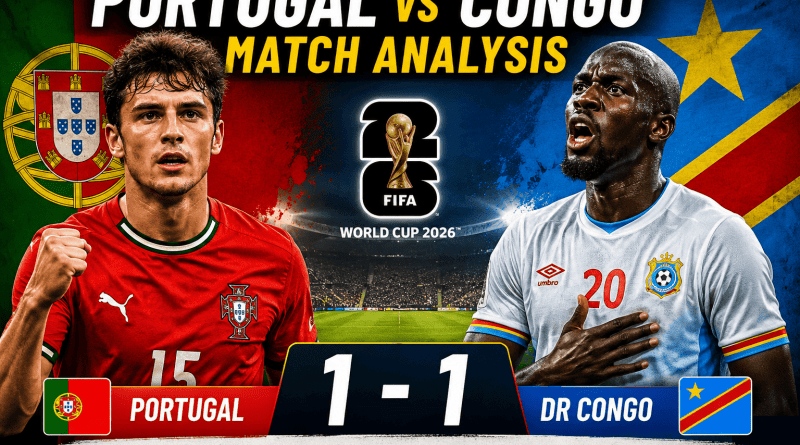
Portugal Vs Congo Result – Post-Match Analysis and Betting Verdict
Match Summary
The FIFA World Cup Group K clash between Portugal and DR Congo ended in a surprising 1-1 draw, a result that left the European side frustrated despite dominating possession and controlling large portions of the game. The final result reflected two very different approaches: Portugal’s technical superiority and territorial dominance against DR Congo’s resilience, discipline, and efficiency in key moments.
Portugal took the lead early through João Neves in the 6th minute after a well-worked move involving Pedro Neto. The goal appeared to set the stage for a comfortable evening for Roberto Martínez’s side, who immediately established control of possession and dictated the tempo.
However, despite enjoying the vast majority of the ball, Portugal failed to create enough clear-cut opportunities. DR Congo remained organized defensively and capitalized on one of their most dangerous attacks just before halftime. Yoane Wissa equalized in stoppage time of the first half (45+5′) following an assist from Arthur Masuaku, stunning the Portuguese defense.
The second half saw Portugal continue to dominate possession, but DR Congo defended intelligently and prevented the favorites from finding a winning goal. Numerous substitutions were introduced by both managers, yet neither side managed to alter the scoreline.
The result leaves Group K wide open and serves as one of the early surprises of the tournament.
How the Match Unfolded
Portugal Controlled the Ball but Lacked Penetration
From kickoff, Portugal implemented their characteristic possession-based approach. The midfield trio circulated the ball efficiently, while the full-backs pushed high to stretch the Congolese defensive block.
The statistics reveal the extent of Portugal’s dominance:
- 75% possession
- 769 completed passes
- 93% passing accuracy
These numbers indicate complete control of the game’s rhythm. However, possession alone does not win football matches. Portugal struggled to transform territorial superiority into high-quality chances.
Although they spent significant time in the opposition half and recorded 29 touches inside the DR Congo penalty area, they often lacked the final pass needed to break down a compact defensive structure.
DR Congo Executed Their Game Plan Perfectly
DR Congo entered the match aware that they would likely spend long periods without possession. Instead of attempting to compete in midfield possession battles, they focused on defensive organization and quick transitions.
Their strategy proved highly effective.
The African side remained compact between the lines, reduced central spaces, and forced Portugal into predictable attacking patterns. Whenever possession was regained, they looked to exploit the speed and movement of Wissa and Bakambu.
The equalizing goal shortly before halftime was a perfect example of their efficiency. One well-executed attacking move resulted in a goal and shifted momentum heading into the break.
Tactical Adjustments After Halftime
Portugal attempted to increase attacking intensity during the second half. Francisco Conceição, Rafael Leão, Gonçalo Ramos, and Nélson Semedo were introduced in an effort to inject pace and creativity.
Despite these changes, DR Congo remained disciplined.
The defensive partnership led by Chancel Mbemba handled aerial threats effectively, while the midfield worked tirelessly to close passing lanes. Portugal continued to circulate possession but rarely created situations that truly troubled the Congolese goalkeeper.
As the match progressed, frustration became increasingly evident among the Portuguese players, leading to a couple of late yellow cards.
Statistical Analysis
Possession
Portugal 75% – 25% DR Congo
The possession statistics clearly demonstrate Portugal’s control of the match. However, the draw highlights an important football principle: possession must translate into meaningful chances.
Portugal dominated the ball but often moved it in non-dangerous areas. DR Congo, meanwhile, was comfortable defending deep and waiting for transition opportunities.
Total Shots
Portugal 7 – 8 DR Congo
This statistic is perhaps the most revealing of the match.
Despite controlling three-quarters of possession, Portugal actually produced fewer shots than DR Congo. This indicates that the Congolese side generated more efficient attacking sequences whenever they moved forward.
Shots on Target
Portugal 3 – 2 DR Congo
Portugal forced slightly more saves, but the difference was marginal considering the disparity in possession.
The lack of quality finishing opportunities ultimately prevented the Portuguese side from securing victory.
Expected Goals (xG)
Portugal 0.64 – 0.82 DR Congo
The xG numbers tell an even more surprising story.
Despite dominating possession, Portugal accumulated only 0.64 expected goals, while DR Congo generated 0.82 xG.
This suggests that the African side created the better scoring opportunities and that the draw was not merely a fortunate result. In fact, based on chance quality, DR Congo arguably produced the more dangerous attacks.
Corners
Portugal 5 – 4 DR Congo
The relatively balanced corner count reflects how effectively DR Congo managed to disrupt Portuguese attacks before they developed into major threats.
Fouls and Discipline
Fouls: 9 – 9
Yellow Cards: Portugal 3 – 1 DR Congo
The equal foul count indicates a competitive and physical contest. Portugal’s higher number of yellow cards reflects growing frustration as the match progressed and their inability to find a winning goal.
Betting Verdict
Recommended Prediction: Portugal to Win
Verdict: Lost ❌
Portugal entered the match as clear favorites due to their superior squad quality, international experience, and technical ability.
On paper, the pre-match analysis appeared logical. Portugal dominated possession, controlled territory, and completed over three times as many passes as their opponents.
However, several factors caused the prediction to fail:
- Inefficient attacking play.
- Lack of clear scoring chances.
- Excellent defensive organization from DR Congo.
- Greater attacking efficiency from the Congolese side.
- Superior xG numbers for DR Congo.
While Portugal controlled the match statistically, football outcomes are determined by goals and chance quality rather than possession percentages.
Therefore, the betting prediction did not materialize despite Portugal’s apparent dominance.
Key Players
João Neves (Portugal)
The young midfielder opened the scoring after only six minutes and was one of Portugal’s most energetic performers.
His movement between the lines created problems for DR Congo throughout the first half, and his goal rewarded Portugal’s strong start.
Yoane Wissa (DR Congo)
Wissa proved decisive by scoring the equalizer just before halftime.
Beyond the goal, he consistently provided an outlet during transitions and demonstrated clinical finishing when the opportunity arrived.
Chancel Mbemba (DR Congo)
Mbemba was instrumental in organizing the defensive line.
His leadership, positioning, and physical presence helped neutralize Portugal’s attacking threats and played a major role in securing an important point.
What’s Next for Both Teams?
Portugal
Portugal will likely view this result as two points dropped rather than one gained.
The performance exposed concerns regarding attacking efficiency against well-organized defensive opponents. Roberto Martínez must find solutions to improve chance creation before the next group-stage fixture.
While qualification remains firmly within reach, Portugal can no longer afford complacency.
DR Congo
For DR Congo, this draw feels almost like a victory.
Taking a point from one of the tournament favorites significantly boosts confidence and strengthens their position within Group K.
The defensive structure and tactical discipline displayed in this match provide a solid foundation for the remaining fixtures.
Conclusion
This World Cup encounter between Portugal and DR Congo demonstrated why football remains one of the most unpredictable sports in the world. Despite enjoying 75% possession, completing 769 passes, and controlling most phases of play, Portugal failed to translate dominance into high-quality opportunities. DR Congo executed a disciplined tactical plan, defended compactly, and maximized the few attacking situations they created. The expected goals metric further supports the notion that the African side generated the better chances despite seeing far less of the ball. From a betting perspective, the match serves as a reminder that possession statistics alone are rarely sufficient for accurate predictions. Future forecasts involving Portugal should place greater emphasis on chance creation and attacking efficiency, while DR Congo has shown they possess the organization and resilience necessary to challenge stronger opponents throughout the remainder of the tournament.